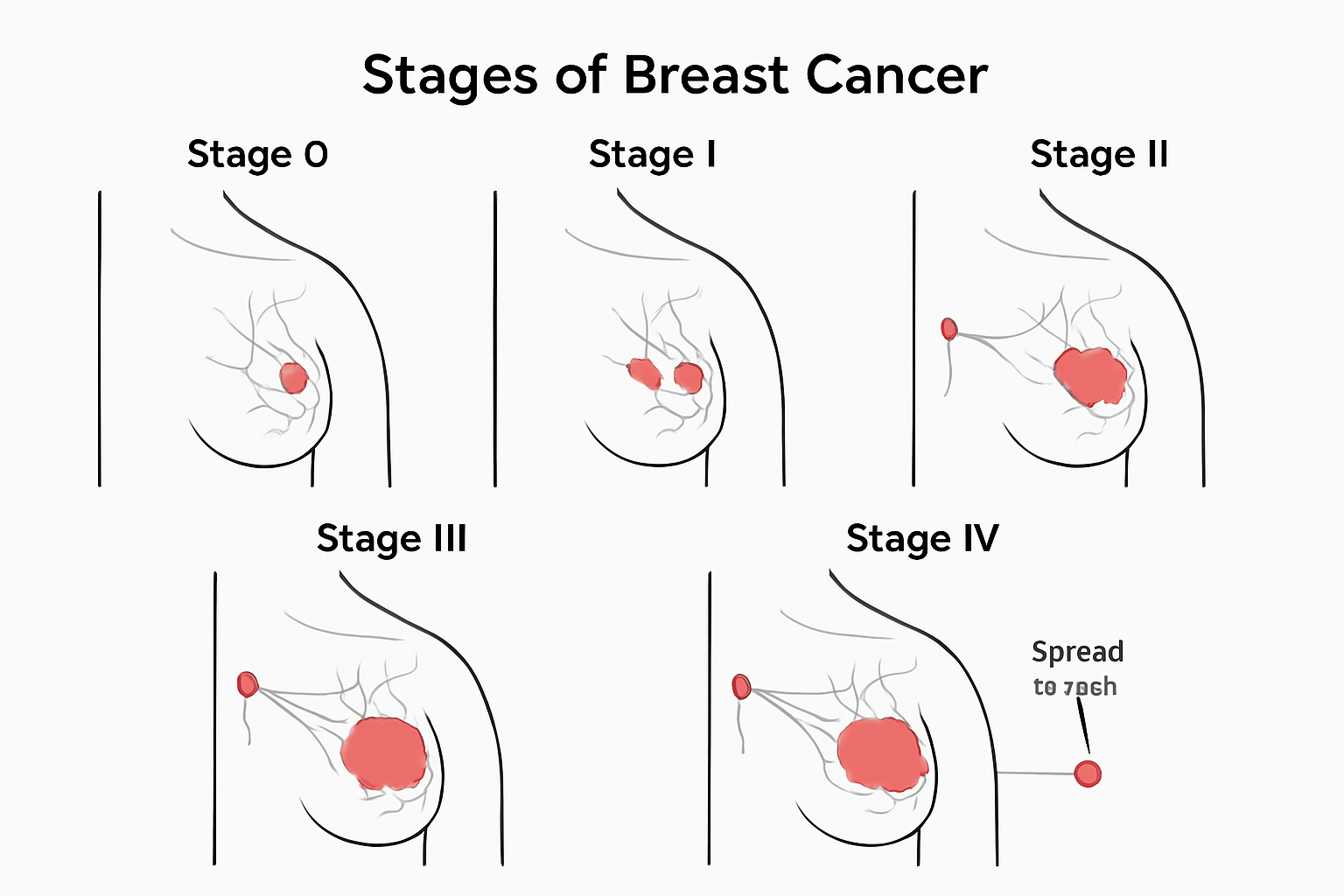
Breast cancer is one of the most common cancers worldwide among women and, less frequently, men. After a diagnosis of breast cancer, a vital next step is determining the stage of the disease. Understanding breast cancer staging helps patients, families, and caregivers make sense of the diagnosis, explore treatment options, and plan for what lies ahead. This guide explains what staging means, how it is determined, and why it matters at every step of a patient’s journey.
Key Takeaway
Staging is a crucial step in breast cancer diagnosis, shaping treatment options and prognosis. Knowing your stage helps you and your care team make informed, personalized decisions.
What Is Breast Cancer Staging?
Staging is a standardized system used by doctors to describe how much cancer is in the body and where it has spread. For breast cancer, this typically relies on the TNM system:
- T (Tumor): Size of the primary tumor in the breast and whether it has grown into nearby tissue.
- N (Node): Whether cancer is in the lymph nodes and to what extent.
- M (Metastasis): Whether cancer has spread to distant organs (such as bones, liver, lungs, or brain).
The combination of these factors results in a “stage,” ranging from Stage 0 (non-invasive) to Stage IV (metastatic). Staging is established by physical examination, imaging studies (such as mammography, ultrasound, MRI, or PET scans), and sometimes biopsy or surgical findings.
The Stages of Breast Cancer Explained
Stage 0 (Carcinoma in Situ)
- Ductal Carcinoma in Situ (DCIS): Cancer cells are found in the lining of the milk ducts but have not spread outside.
- Lobular Carcinoma in Situ (LCIS): Abnormal cells are found in the milk-producing lobules but are not considered true cancer, though they indicate increased risk.
- This stage is non-invasive. The abnormal cells have not invaded surrounding breast tissue.
Stage I (Early Stage Invasive Breast Cancer)
- Cancer has started to invade nearby normal breast tissue but is small in size (usually 2 centimeters or less) and has not spread to lymph nodes (Stage IA), or there are tiny amounts in very few lymph nodes (Stage IB).
- Early detection often leads to Stage I diagnosis, which offers a very favorable prognosis.
Stage II (Localized Spread)
- Tumor is larger (between 2 and 5 centimeters) or has spread to nearby lymph nodes but not to distant parts of the body.
- Stage II is further broken down into IIA and IIB, depending on tumor size and lymph node involvement.
- Treatment is often effective, but approaches may be more complex than Stage I.
Stage III (Regional Spread/“Locally Advanced”)
- Cancer is larger than 5 centimeters and/or has spread more extensively to underarm or nearby lymph nodes but has not reached distant organs.
- This stage is sometimes called “locally advanced breast cancer.”
- Stage III is subdivided into IIIA, IIIB, and IIIC based on the extent of lymph node involvement and spread to nearby tissues, such as skin or chest wall.
- Stage III is serious but still potentially curable with aggressive treatment.
Stage IV (Metastatic Breast Cancer)
- Cancer has spread beyond the breast and regional lymph nodes to other organs (metastasis), such as bones, liver, lungs, or brain.
- This is considered “advanced” or “metastatic” breast cancer.
- Treatment focuses on controlling disease, relieving symptoms, and improving quality of life.
How Is Breast Cancer Staging Determined?
Staging usually happens after a combination of tests and procedures, including:
- Physical examination of the breasts and lymph nodes.
- Imaging studies like mammogram, breast ultrasound, MRI, CT, or PET scans.
- Biopsy of the breast tumor and sometimes lymph nodes to examine cancer cells under a microscope.
- Surgical findings after a lumpectomy, mastectomy, or lymph node surgery can affect the final stage determination.
In some cases, additional genetic and molecular testing of the cancer cells will further characterize the disease, which can affect both staging and treatment planning.
Why Is Staging Important?
- Guides Treatment Choices: The stage determines whether surgery, radiation, chemotherapy, hormone therapy, targeted therapy, or a combination may be recommended.
- Estimates Prognosis: Lower stages usually mean better chances for cure, while higher stages require more complex management and may carry a different outlook.
- Enables Comparison: Staging allows doctors worldwide to understand results, discuss cases, and compare treatments and outcomes.
- Facilitates Research: Staging is crucial for clinical trials and new therapy development.
Additional Factors That Influence Staging
While the TNM system forms the basis, other factors can also influence how breast cancer behaves and how it is treated. These include:
- Hormone receptor status: Whether the cancer cells are sensitive to estrogen or progesterone.
- HER2 status: Whether the tumor overexpresses a protein called HER2, which can affect growth.
- Grade: How abnormal the cancer cells look under the microscope (low, moderate, or high grade).
For this reason, the American Joint Committee on Cancer (AJCC) includes these features alongside the TNM stage in newer staging systems, called “prognostic stages.” Individual treatment planning takes both anatomy and biology into account.
How Staging Impacts Treatment Options
Your breast cancer stage is often the main starting point for treatment planning. Here is how treatments often differ by stage:
- Stage 0: Treatment may involve surgery (lumpectomy or mastectomy), and sometimes radiation. Medications may be used for risk reduction.
- Stage I-II: Treatments often include surgery to remove cancer, sometimes radiation, and often systemic therapy (like hormone therapy, chemotherapy, or HER2-targeted therapy) based on additional tumor features.
- Stage III: Usually requires more intensive treatment—often chemotherapy before surgery (neoadjuvant therapy), surgical removal, radiation, and possible additional drugs.
- Stage IV: Focuses on systemic therapies (chemotherapy, hormone therapy, targeted agents, immunotherapy) and supportive care rather than surgery; local treatments may sometimes be used to control symptoms.
Every person’s care plan is unique, based not just on stage, but also on general health, personal preferences, and cancer biology.
Questions Patients Often Have About Staging
- Can the stage change over time? Yes. The “stage at diagnosis” doesn’t change, but if cancer comes back (recurs) or spreads, it may be called “recurrent” or “metastatic” cancer. Treatments will then change accordingly.
- Is a higher stage always a worse outcome? Not necessarily. Treatments are improving, and some higher-stage cancers respond very well to modern therapies. Cancer biology is just as important as cancer stage.
- Should I seek a second opinion? Many patients do, especially if faced with complex or late-stage cancer. It can help you understand all your options.
What Patients Should Know
- Understanding your breast cancer stage empowers you and your loved ones to ask informed questions and participate in treatment decisions.
- If you do not understand your stage, ask your doctor to explain or provide written information—it’s your right.
- Remember: Stage is just one part of the story. Emotional support, nutrition, and managing side effects are important at every stage. Many people live full and active lives through and after breast cancer treatment.
- For further reading, consider the American Cancer Society, Cancer Research UK, and Breastcancer.org, all of which offer detailed and regularly updated patient guides on staging and treatment.
Sources
American Cancer Society (“Breast Cancer Stages”), National Cancer Institute, AJCC Cancer Staging Manual, Breastcancer.org, Cancer Research UK.
Leave a Reply